How to Apply for a Certificate of Public Convenience in LTFRB?
If you want to run a jeepney, UV Express, bus, van, shuttle, truck-for-hire, or other land transport service legally in the Philippines, the Certificate of Public Convenience in LTFRB is one of the most important documents you need to understand. It is the authorization that allows a public transport service to operate under LTFRB rules, and it sits at the center of route approval, unit authority, renewal, and franchise compliance. The good news is that once you understand the legal basis, the filing route, and the kind of documents LTFRB expects, the process becomes far less confusing.
What a CPC Really Means for Your Transport Business
A CPC is the legal authorization issued by the LTFRB for the operation of land transportation services for public use. In plain terms, it is the franchise authority that lets an operator legally transport passengers or cargo on approved services and routes. Without it, a public utility operation is exposed to enforcement risk, route issues, and registration problems tied to franchise status.
The Law Behind the CPC Requirement
The legal backbone is the Public Service Act, or Commonwealth Act No. 146. Lawphil’s published text shows that certificates of public convenience are issued when the public service proposed will promote public interest in a proper and suitable manner, and it also preserves the Filipino ownership rule for applicants. In practice, that means the applicant must not only qualify legally but must also show that the proposed service is fit for public need and proper operation.
Who Can Apply Under Philippine Rules
The Public Service Act requires that the applicant be a Filipino citizen, or a Philippine entity with the required level of Filipino ownership. The same legal framework also expects the applicant to show financial capability and that the proposed service will serve public interest properly. Those three ideas, citizenship or qualified ownership, financial capability, and public interest, are the foundation of any serious CPC application.
The Main CPC-Related Applications You Should Know
Many operators think CPC work only means “new application,” but LTFRB’s current NCR online portal shows several related franchise transactions. These include extension of validity, confirmation of units, provisional authority, register in lieu, dropping of unit, dropping and substitution, extension with dropping and substitution, motion, franchise verification, and consolidation. That matters because choosing the correct service type at the start can save a lot of time and re-filing.
Where You Can File Today
LTFRB NCR’s online portal already uses a digital workflow that follows a simple pattern: apply and upload files, pay through merchants, then wait for approval. The same portal also lets operators create accounts based on ownership type, such as single proprietorship, partnership, corporation, or cooperative. Outside NCR, you should still check with the correct regional franchising office because filing practices can differ by office and service type.
The Documents That Usually Matter Most
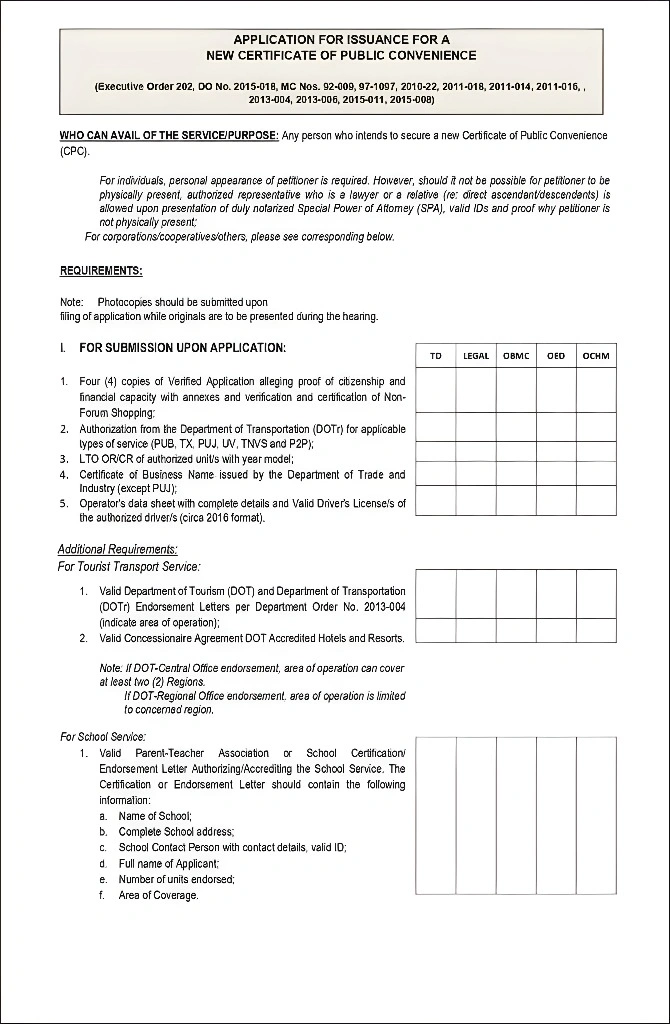
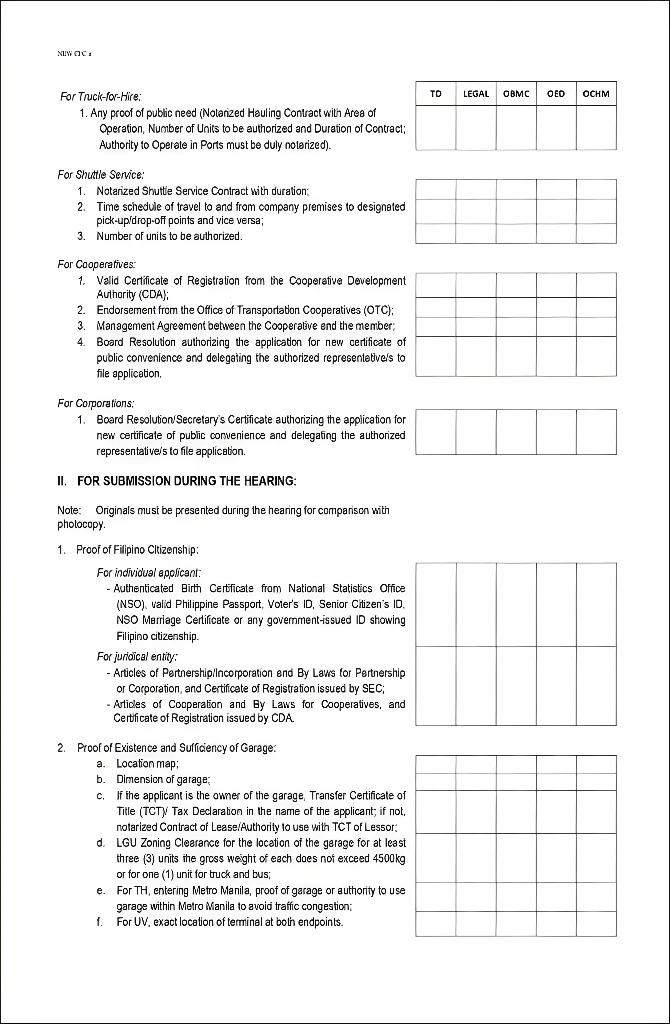
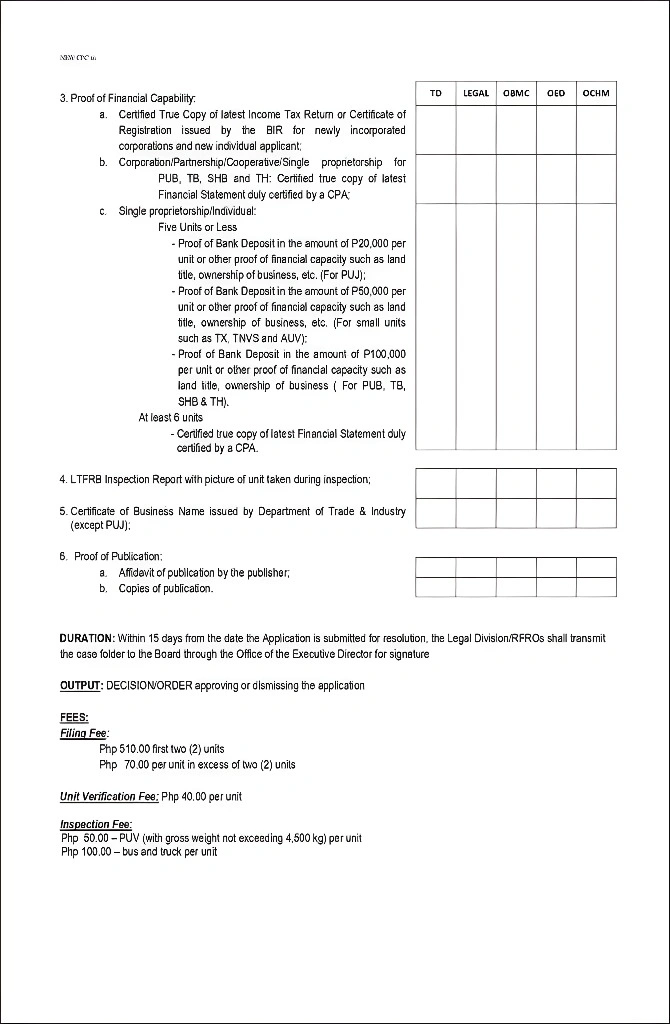
The exact checklist depends on the type of service and the kind of CPC-related application you are filing, but the recurring themes are consistent: completed application papers, proof of citizenship or ownership structure, proof of financial capability, vehicle records, garage or route details, and supporting business documents where applicable. Copies of the LTFRB application form circulating online also reflect these same categories, including verified application papers, OR/CR, business name papers, operator data, and garage-related information, while the law itself focuses on ownership, financial capability, and public-interest justification.
A Simple Step-by-Step Filing Flow
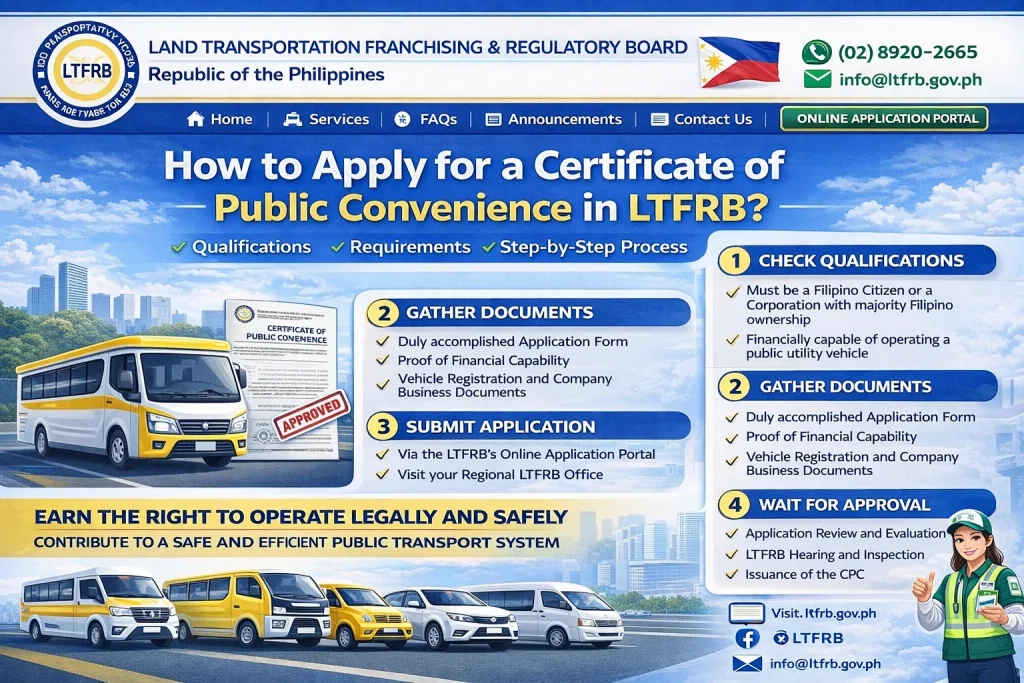
A practical CPC filing path looks like this: first, prepare your application package and gather all supporting records; second, file through the proper LTFRB channel, which may be the regional office or the NCR portal depending on your case; third, pay the required charges; fourth, wait for evaluation and any additional compliance steps tied to the case; and finally, once approved, operate only within the route, service type, and unit authority stated in the CPC. LTFRB’s NCR portal confirms the digital filing flow, while CPC rules and related issuances make clear that compliance continues even after approval.
What Happens If Your Franchise Is Expiring
This is where many operators lose time. LTFRB NCR’s portal states that a CPC holder can already apply for extension of validity one year prior to expiration. Older LTFRB memoranda also show that extension rules are time-sensitive, so late filing can become its own problem. The safest practice is to treat CPC renewal preparation as an early compliance task, not a last-minute rescue.
Can You Operate While the Main Application Is Still Pending
LTFRB’s NCR portal describes provisional authority as a remedy for persons who intend to operate unit or units while franchise applications are pending with the agency. That does not mean every applicant is automatically cleared to operate, but it does mean there is an official mechanism for temporary operating authority in the right cases. Operators should not assume this is automatic; it is something that must be applied for and granted under LTFRB rules.
Fees and Charges You Should Budget For
Fee schedules can vary depending on the application type, the number of units, and the transport category, so it is smart to confirm the current schedule with the regional office before filing. A widely cited CPC filing guide based on LTFRB materials lists the following common figures for new CPC filings: ₱510 filing fee for the first two units, ₱70 per unit in excess of two, ₱40 unit verification fee per unit, and inspection fees that may differ by vehicle class. Treat these as planning figures, not the final word, until your RFRO confirms the exact assessment for your case.
How Long a CPC Normally Lasts
LTFRB memorandum issuances preserved the five-year validity period of the CPC, and judiciary-published references continue to reflect that five-year term. In practical terms, that means operators should manage CPC compliance on a multi-year cycle, but they should start extension or renewal preparation well before the expiry date rather than waiting until the last moment.
Common Reasons Applications Get Delayed
Most CPC delays do not come from one dramatic problem. They usually come from incomplete papers, wrong application type, missing proof of financial capability, unclear vehicle records, poor route or garage documentation, or filing too close to expiry. The easiest way to reduce delay is to match your service type to the right filing category, verify your unit records before submission, and make sure your ownership and financial documents are internally consistent.
FAQs
Conclusion
A CPC is not just a permit you file once and forget. It is the legal foundation of your LTFRB transport authority, and it affects how you operate, renew, substitute units, confirm units, and protect your franchise position. If you prepare early, file under the correct service category, and keep your documents consistent, the process becomes far more manageable than it first appears.